Tales From The Camping House

Tales From The Camping House

Friday, June 28, 2013

Walking The Streets of San Francisco With Emperor Norton

We were going to leave Lotus on Tuesday, but it began to rain and we decided to stay another day.  Wednesday, we drove approximately 180 miles to the Thousand Trails in Morgan Hill and will be staying put until after the 4th of July.

Luckily we were able to get a 50 amp site.  Another high pressure cell is coming in pushing the temperatures near 100 this weekend.

Today we headed to San Francisco which is 70 miles from us and has much cooler temperatures.  Today's high was 72.

We had reservations today at 11:00 to take Emperor Norton's Fantastic San Francisco Time Machine Tour .  It was a walking history tour of San Francisco's Union Square and Financial District.

We arrived at Union Square an hour early giving us plenty of time to park and check out things around it.


The park is one square block and acquired its name when pro Union rallies were held in the square during the Civil War.  Today it is the center of shopping and theaters in the city.


We were told to meet by the statue and that's where we went.


There was Emperor Norton ready to take 16 of us back into history.

Emperor Norton originally came to San Francisco after inheriting $40,000 from his father.  He was able to invest and turned the original amount into $250,000.  He then tried to corner the rice market and lost all of his money.

He left San Francisco for awhile.  When he came back, he proclaimed himself Emperor of the United States and Protector of Mexico issuing edicts and proclamations.  The people of San Francisco humored him as he held court among the people.  You can read more about him here if you would like.


First on the tour was the St. Francis Hotel, built in 1904.  It survived the Great San Francisco Earthquake of 1906 and suffered little serious damage from the resulting fire.  Reconstruction began immediately and it reopened in 1907.


This Magneta Grandfather Clock was the first master clock, controlling all the other clocks in the note, brought to the west and has served as a meeting place for San Franciscans since it was installed in the Powell Street Lobby in 1907.  If you live in San Francisco and say meet me at the clock, everyone knows this is the clock to meet at.


Before the Neiman Marcus store, the City of Paris Department Store was there.  In the 1970's, there was quite a bit of controversy as Neiman Marcus acquired the property, tore down the City of Paris and built the new building. They did keep the stained glass rotunda that had been in the City of Paris.  You can see it at the top of the glass in the center.


We continued to the Xanadu Gallery designed by Frank Lloyd Wright.  The red tile is his signature mark.

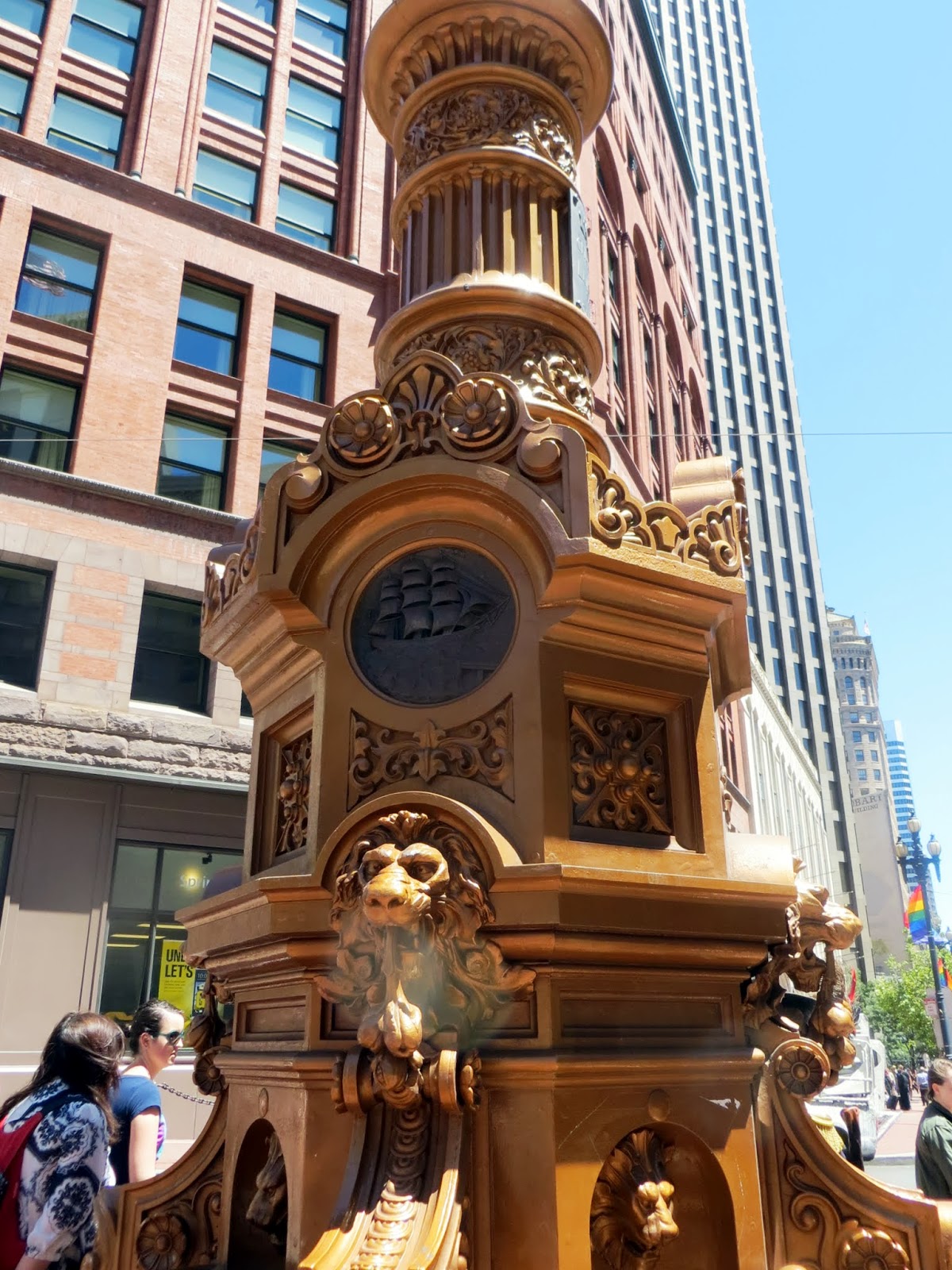
This is Lotta's Fountain given to San Francisco in 1875.  Lotta Crabtree was popular entertainer who began as a young child traveling with her mother to miners' camps to sing and dance for them.
The Palace Hotel also survived the earthquake in 1906.  Enrico Caruso, the opera singer, was staying here and thought the trauma had caused him to lose his voice. His manager persuaded him to try to sing.  Caruso opened the windows and sang down to the streets of San Francisco.  He then left the city vowing he would never be back.  He never returned.


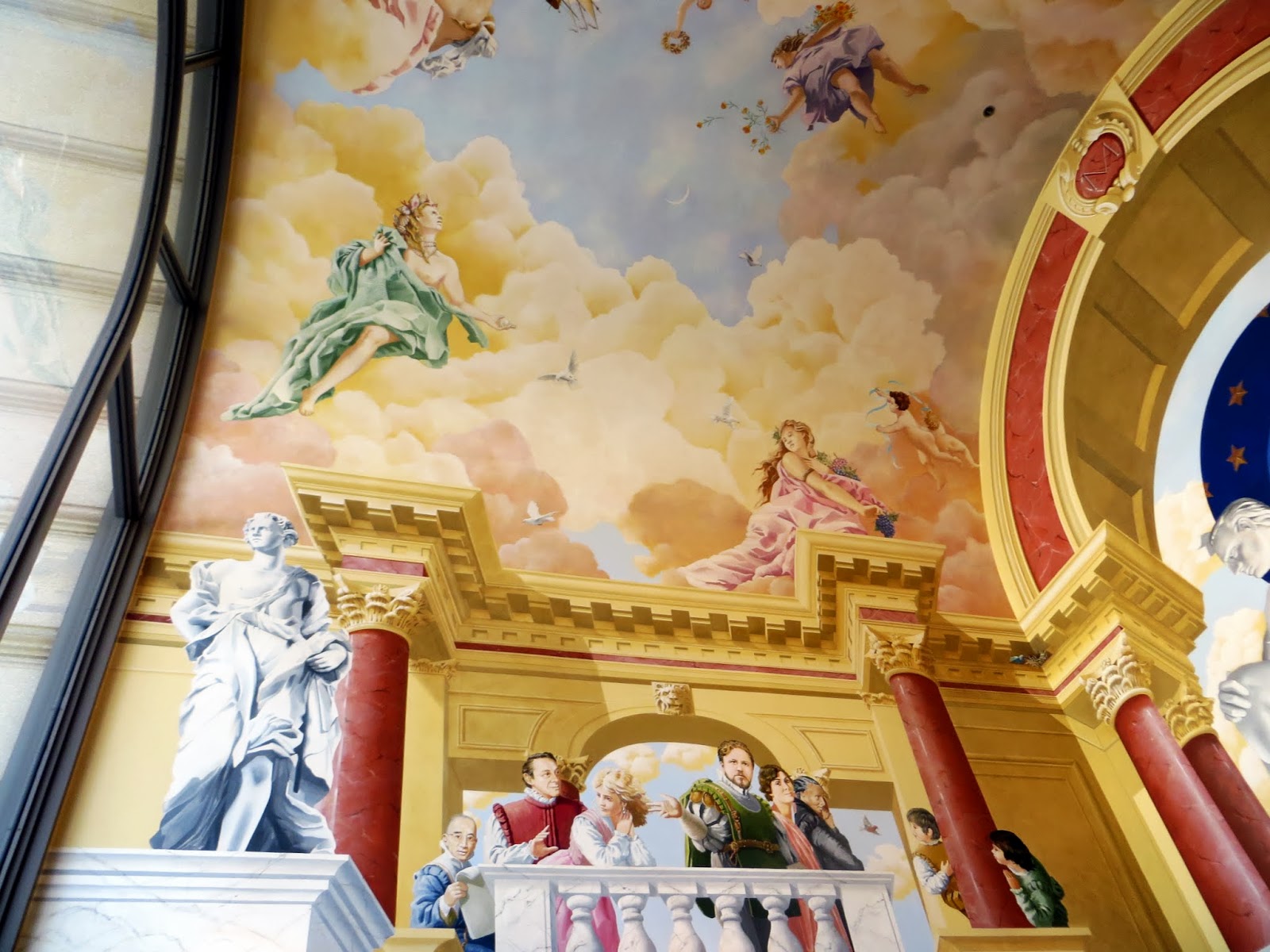
This was an office building with these painted murals in the entrance. Each person in the mural was someone important in San Francisco.

Next, we headed to the Transamerica Building, the tallest building in San Francisco.  Another interesting fact we learned is that San Francisco has POPOS (privately-owned public open spaces), most of them downtown. Pictures below is the POPOS of the Transamerica Building.

One of my favorite stops was this Artist & Craftsman Store which was originally a dance theater on the Barbary Coast.  It was amazing the amount of supplies they had on two levels.  It was a real treat to go inside and walk into an original tunnel that had been used to smuggle goods in and out of the city.  Apparently there was an entire network of tunnels connecting stores on the Barbary Coast to enable smuggling.


Our last stop was China Town with its unique architecture and street signs that are in both English and Chinese.

We walked back to our starting point passing a trolley car on the hills.


We ended our day back at our original destination.  We enjoyed hearing stories of San Francisco's past giving the structures in the city meaning.  It's such a great way to visit a city.


Monday, June 24, 2013

Looking for B.F. or Our Version Of "Who Do You Think You Are"

One of the reasons we are staying in this part of California is for me to do some research and find some information about my great, great grandfather who came here in 1850 with many, many others to search for gold.

I had found him in the 1852 California Census as a miner living on the Middle Fork of the American River in Placer County.

Today, we went to Auburn, the county seat of Placer County, to the Placer County Archives.

The ladies at the archives were wonderful.  I went in and told them what information I had and they began to help me look bringing out binders to look through as well as looking in the records on the computer.

An 1856 court case was found with B.F. Huntington as one of the plaintiffs.  The complaint was regarding a mining claim and the landmarks were given where we were able to come up with a pretty good idea of the location.

They pulled out a map from 1890 that showed the location.


I was able to get copies of the 26 page file of court documents.  It will take me awhile to read through it completely.  We also found another record where my great, great grandfather sold his original mining claim.  It was a "gold mine" of information. :)

We were about 15 miles from the general locality of the claim, so when we finished at the Archives about 1:30, that was our next destination.


We drove out I-80 toward Reno and got off at a state highway leading to


Yankee Jims was one of the largest gold camps in Placer County during the California Gold Rush.  It was estimated to have as many as 5,000 people in the 1850's.

We took Yankee Jims Road heading to the American River.  The road soon turns into this 5 miles of what the signs call primitive road.


It was asphalt, but just a little wider than one lane and many times you could just look out the window and see how easily you could just slide off the side of the road into a very deep canyon.  I kept leaning over to Jim's side like that would make a difference in keeping us on the correct side of the road.


As we were slowly driving along, Jim says we are on our own Who Do You Think You Are adventure.  He asked, isn't that what they do on that show you watch when they are looking for information about their ancestors.  I said at least they have a film crew who will know if they go off the side of the road. ;)

There hasn't been any rain, but today there were some showers, the low hanging clouds were pretty through the valley, in an eerie sort of way.


It took us awhile, but we did arrive at the river.  This is the Yankee Jim's Bridge, the 4th bridge that has gone over the river.  It is a suspension bridge, this one built in 1930.


You can still drive over the bridge, it has a 3 tons limit, but we chose not to.  It is rated a 3 out of 100 on the structural scale.  We were told about the website Bridgehunter.com where you can look up pictures of historic and notable bridges throughout the U.S.  Before we left, we looked up the bridge.


We walked to the middle of the bridge and took pictures of both sides.


According to the court records we had found, my gg grandfather's claim was pretty close to this location.


We didn't stop too long as the rain was beginning to come down harder and we still had to make it back on the same road we had come down.

Jim stopped to go into this little cave we later found out had probably been dug out by miners to keep warm.

We left and made it safely back to the highway.  It was much easier for me since I was on the side of the mountain rather than looking down in the canyon.

It was a very fun day of family history.

Saturday, June 22, 2013

Back To Sacramento To Visit The Capitol

When we went to Sacramento last week, we did not have time to go see the capitol building, so today we made the journey back to visit.

California became a state in 1850 with the discovery of gold and the influx of miners and settlers to the state.  They became a state so fast, they didn't even have a chance to be a territory first.

The state did not have a permanent seat for the government until 1860.  Towns vied for the spot, but Sacramento was the final decision.  Groundbreaking for the capitol was December 4, 1860, but was not officially completed for 14 years.  In 1869, it was completed enough for the Legislature and Governor to move into.


After going through the security check, we walked through these beautiful domed halls


and arrived in the Rotunda with a life-size Carrara marble statue entitled Columbus' Last Appeal to Queen Isabella.  It has been there since 1883.


Looking up through the dome was pretty amazing!


As we continued through the building, we stopped to look out the front door at this view of Sacramento.


Continuing on, there are three rooms set up to represent the Governor's Office in 1906.


Then, the Secretary of State's office from 1902.

This is a stained glass representation of the Great Seal of California installed on the ceiling in 1907 showing off an exciting technological advance, using electricity instead of sunshine to light it.


Next, we went to the Senate gallery.  We loved the chandeliers hanging from the ceiling.


Our last stop inside was the Assembly Chamber.


The grounds outside are also quite extensive.


We walked through the grounds looking at the statues and plants, there's even an orange tree there!


The California State Capitol Building is certainly worth a stop if you are ever in Sacramento.