Tales From The Camping House

Tales From The Camping House

Sunday, June 9, 2013

Wrapping Up Yosemite


Saturday, we pretty much stayed inside except for the times Jim took the boys out for their walk.  It got up to 101 degrees, but then Saturday night it cooled down and the high on Sunday was in the 70's.

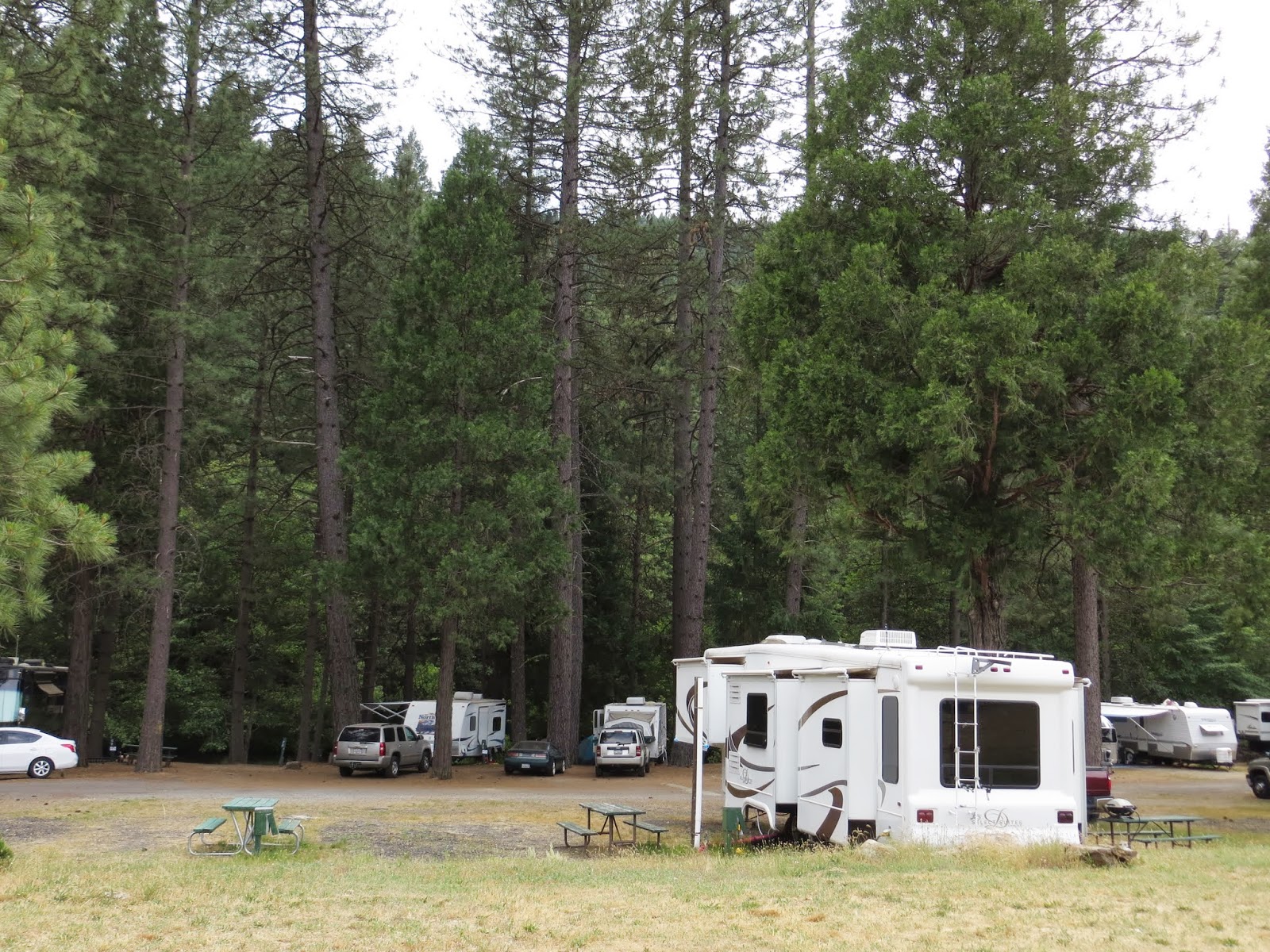
We have spent the last 18 days at Yosemite Lakes Thousand Trails RV Park between Groveland and the Yosemite Gate.  It's been a great place, but it has been difficult without internet and cell phone coverage.  We have made several trips down the mountain just to get our Internet fix and post my blogs.  The park has wifi, but it is only at the clubhouse and is so slow all you can do is check you e-mails.


So today, we wanted to go back and see Yosemite one more time.  The Milkweed were in bloom, but there weren't any Monarch butterflies.  We did get some great pictures with Yosemite Falls.


We didn't get a Monarch on the Milkweed, but we did get this butterfly on it.


The only road we had not take in Yosemite was the one leading to the Ahwahnee Hotel.  It's in a beautiful setting.


We parked and began to explore the grounds.  The Ahwahnee opened in 1927 and has entertained national figures such as Queen Elizabeth II and President John F. Kennedy.

We took the path around the hotel and to the Ahwahnee Bridge.


Walking over the bridge, there was a great view on each side.


We walked across and continued a way on the trail.


We looked to the right and had an even closer view of Half Dome.


On our way back, we spotted this mama duck and her ducklings.


This is the Great Lounge in the hotel which features three fireplaces large enough to sand in, plus overstuffed sofas and chairs.


On our way out, we made one last stop to view the park.


We loved Yosemite and have made lots of great memories!

Friday, June 7, 2013

Columbia State Historic Park


Today, we made the trek down the mountain.  Our destination was the Columbia State Historic Park which has preserved the town's old Gold Rush-era business district with shops, restaurants, and two hotels.  


We arrived about 10:30 and found out there would soon be a walking tour.  We went through the museum and we were ready to begin the tour.  At first it was just Jim and I, then we were joined by several families.  The tour was led by a California Park Ranger who was extremely informed on the town's history.


He began by telling us about how much miners found a day in gold, usually about $10, but they were not able to keep all of that.  There were quite a few expenses, the biggest one being water for them to mine placer gold (mining for gold by sifting through the sand or gravel).  Many became discouraged and left, but many others stayed with the hope of striking pay dirt.

There were many stories of overnight riches and overnight losses.


A stagecoach came in while we were at the Wells Fargo Building.  You can purchase tickets to ride the stagecoach.


Since we were on the walking tour, we were able to go inside the building.


This was the place that had the best reputation for paying a fair price for gold.  Miners would line up for  blocks to wait to trade in their gold for money.  They were also able to pick up mail and packages here as well.


Another building we visited was the Volunteer Fire Department.  In 1854, fire destroyed everything in the Columbia business district except for one brick building.  When the town was rebuilt, locally produced red brick was used for thirty buildings.  In 1855, the New England Water Company provided piped water for firefighting and domestic use.  Seven cisterns, each with a capacity of about fourteen thousand gallons, were build under the streets.

In 1857, another fire destroyed all the frame structures in the 13-block business district, as well as several of the brick buildings.  This time the citizens decided to form a volunteer fire department.  In 1859 the fire department acquired the Papeete, a small fancifully decorated fire engine.  We were told that this was originally intended for a King in the Tahitian Islands, but as it was being shipped by freighter, the crew jumped boat in order to mine.  The fire engine went to San Francisco and was then purchased by the people in Columbia.  On either side of the high frame, above the body of the engine were "splendidly executed Sandwich Island angels, something like the complexion of a new saddle." There was concern as to what the Columbians would think of these nude bathing figures and so "nice screens fitted over them."

The engine is still in working order.


Our last stop was the general store which has been restored to its original condition.  The items in the store are reproductions.  By the time we had finished our tour, it was just Jim and I.  The kids in the group could only last so long and our guide had told everyone in advance, if you needed to leave early, that was fine.

The tour was a wonderful way to find out about the history of another gold mining town.


On our way out, we stopped at this bowling alley where families were able to bowl down the lane, then set their wooden pins back up.


Columbia State Historic Park was another great place to visit.

Thursday, June 6, 2013

The Town That Time Forgot

When we were at Mono Lake last week, we spoke to a couple who told us if we came back this way to consider seeing Bodie. We did some research and decided to make the 80 mile drive today. We had to go through Yosemite to get to the other side and then take a dirt road the last ten miles taking us two hours and forty minutes. As we were driving the last few miles on the dirt road, we were hoping the trip would be worthwhile.


Bodie was a gold rush town with as many as 10,000 people during its heyday in the 1880's and today only about 5 percent of the buildings it contained remain. It was made a state historic park in 1962 and is now maintained in a state of "arrested decay." Most people had left the town by the 1930s leaving behind things they couldn't take with them.


As we walked from the parking lot, you felt like you had been transported back in time and were getting a glimpse of the way things were.

Large machinery is strewn in the field.


This house belonged to the man who owned the Standard Mine. This was a bay like window with a large display of bottles and glass insulators.


You can't go inside the buildings, you can only look through the glass. I found out if I put my camera lens right on the glass I could get a pretty good picture of the inside.


It just looks like the people were just whisked away.


This was the firehouse. One recurring theme in the life of western towns is how often fire destroys them. There was a big fire in July, 1892 that wiped out all but a few buildings in the business district and then again in 1932, a small boy playing with matches started another fire. Each time there was plenty of water available, and the fires could have been stopped, but the screens at the reservoirs had not been replaced after cleaning, and the pipes were clogged with rocks and mud.


Inside were this neat wagon and pump.


This was the barber shop and one of 65 saloons in the town.


Here is the general store complete with old gas pumps and a 1927 truck.


The window displays are still there.


We spent a lot of time looking inside, reading the signs and identifying items in the store.


The siding on the side of the store was made from 5 gallon kerosene and gasoline cans that had been brought in from Carson City and Hawthorne.


Here's the schoolhouse built in 1879.


It was interesting looking inside. On the bottom left appears to be a toy or model to demonstrate mining.


Here is the Standard Mine. You can only go in it on a guided tour.


This is a room in one of the hotels complete with a billiard table.


This was the vault from the bank. The bank building burned down in 1932 and this vault was all that was left.


Here's the jail. It doesn't look like much now, but it was pretty sturdy. Only one prisoner is known to have escaped. Bail for "guests" was $5.


As we were leaving we saw this blue bird on the sign where the one room cabins belonging to the "ladies of the night" were once located.


We spent three hours in Bodie and could have spent even more time, but we were hot and hungry. We were glad we had brought a picnic lunch with us as there are no food facilities at the park.

We took another road back to the highway, but this time we only had to drive 3 miles on a dirt road.

We stopped at the


where we saw this reflection in the water.


The visitor center was wonderful. We watched two movies there, one about the lake and another about mining. We found out about sand tufas in the area. We had seen the calcium tufas the other day, but once we heard about the sand tufas, we had to find them.

They look like sand castles.


Before we began our journey home, we stopped at the Whoa Nellie Deli. It's inside the Mobil Station, but that certainly doesn't take away from the food. We shared a delicious piece of double chocolate cake.

We both agreed the sights we saw today were definitely worth the journey!